County Council Monthly Report September 2026

In this report:
- Full Council
- Local Government Reorganisation
- Unpaid carers invited to share their experience
- Shaping the future of adult social care
- Homelessness and temporary accommodation in rural areas
- Minerals and Waste local plan
- Rights of Way improvement plan
- Bus service proposed changes
- 20MPH programme review
FULL COUNCIL
The non-aligned Independent on the council (elected as Reform in 2025, later became Independent, briefly joined Advance UK, then returned to being Independent) has now joined the Conservative Group. The council’s current composition is therefore
Liberal Democrat and Independent 33
Conservative 11
Reform UK 9
Labour 5
Green 3
The next meeting of the full county council is on Tuesday 13 October.
LOCAL GOVERNMENT REORGANISATION
All plans are now withdrawn and under review. The work that officers have done and the money that has been spent is now suspended. It seems (at the moment) that the normal elections for existing councils will go ahead in 2027.
ADULTS & HEALTH
Unpaid carers invited to share their experience
Unpaid carers across Cambridgeshire are being invited to share their experiences to help shape the future of support services in the county.
Cambridgeshire County Council is bringing together unpaid carers, people with lived experience, local organisations and others with an interest in supporting carers to design future Adult Carers Support Services.
The council is keen to hear from people who provide care for family members, friends or neighbours, as well as young adult carers and others with experience of caring. Their insights will help ensure future services reflect the needs of carers and the people they support.
A series of workshops will take place between September 2026 and March 2027, giving participants the opportunity to help develop future service priorities, shape how services are delivered and contribute to wider commissioning plans. There is no expectation that people attend every session, with all involvement welcomed based on individual availability and interests.
The workshops will build on feedback already shared by carers and provide another opportunity for people to influence how support is delivered in future.
Anyone interested in taking part, or who would like more information, can contact Commissioning.FPTeam@cambridgeshire.gov.uk
Shaping the future of adult social care
People across Cambridgeshire are being encouraged to have their say on the future of adult social care as part of a national public engagement programme launched by Baroness Louise Casey.
The Big Conversation on Care, launched on 29 July, aims to give people across England a direct opportunity to influence the future development of a National Care Service and how care and support will be provided for years to come.
The commission is seeking views from the public on a range of issues, including who should be eligible for support, what role families should play in caring for loved ones, and how care should be funded in a fair and sustainable way.
The programme will run until April 2027 in two phases. The first phase, running from July to November, focuses on the values and principles people expect from the care system and who should receive support. The second phase will look at funding, delivery and long-term reform of adult social care.
Find out more and take part at www.caseycommission.co.uk/bigconversation
COMMUNITIES, SOCIAL MOBILITY AND INCLUSION
Homelessness and temporary accommodation in rural areas
The County Councils Network (CCN) has published new analysis on homelessness and temporary accommodation in county and rural areas, showing that it is not just a big city problem.
- In March this year 23,186 children in county and rural areas were in temporary accommodation—74 per cent more than six years ago, almost double the national increase, and five times the increase in London.
- In March 2026 there were 22,230 households in temporary accommodation in county and rural areas, an increase of almost 80 per cent over the last six years. Almost one in five of these households are based in expensive ‘nightly paid’ private accommodation.
- Councils in county areas spent £124M on temporary accommodation in 2019/20, rising to £373M in 2024/25. This trebling of spend is a faster rate than anywhere else in England.
- Homelessness is also continuing to rise across county and rural areas, with local authority costs soaring in response: in 2019/20 councils in county areas budgeted £161M for homelessness, but this increased to £447M this year.
ENVIRONMENT AND GREEN INVESTMENT
Minerals and Waste local plan
Consultation on this stage of the plan is still open and closes on 10 October. Here is the link:
www.cambridgeshire.gov.uk/mwlp-review
HIGHWAYS & TRANSPORT
Rights of Way improvement plan
The County Council has now begun its review of its Rights of Way Improvement Plan and is seeking comments from parish councils and other stakeholders.
Comments are now invited on key questions about our local rights of way network, and the priorities residents would like to see in a revised Plan. Comments can be made at https://yourvoice.cambridgeshire.gov.uk/place-and-sustainability/95349146/
The deadline for responses is Sunday 11th October. If you have any questions about completing the questionnaire, please write to Rowip2026@cambridgeshire.gov.uk
Bus service proposed changes
The current network map shows:
T3: Grantchester → Trumpington → Addenbrooke’s → Queen Edith’s Way → Fulbourn
T4: Newmarket → Fulbourn → Queen Edith’s Way → Addenbrooke’s → Trumpington Park & Ride
Queen Edith’s Way is currently served by both T3 and T4, providing an orbital connection between the Addenbrooke’s area and the east/south-east of Cambridge. The proposal essentially combines/reconfigures T3 and T4 into a new Service B. The proposed Cambridge Revised Service B will run:
Newmarket → Fulbourn → Queen Edith’s Way → Addenbrooke’s → Trumpington Park & Ride, with the service continuing towards the south/west on the wider network.
It will continue to run approximately hourly during the day, Monday–Saturday, with broadly the same first and last bus times.
Service B will use Hills Road only during school and college travel times. Outside those times, it will operate direct via Queen Ediths Way. This appears to be intended to improve reliability by avoiding the more congested Hills Road corridor outside the periods when it is needed for schools and colleges.
The T3 section between Addenbrooke’s and Fulbourn is withdrawn. However services 1 and B will maintain the connection, but the structure of the service changes.
The proposed network still gives Queen Edith’s a direct Addenbrooke’s connection.
The 114 is also being considered in the wider review. It runs: Chesterton → Cambridge → Addenbrooke’s Hospital.
The report does not publish actual ridership numbers but the cost per passenger is a factor in the considerations. Please get in touch is you have any concerns.
20MPH programme review
The first-year evaluation of eight 20MPH schemes introduced across Cambridgeshire since early 2024 indicates that the programme has been effective in reducing vehicle speeds. All eight locations recorded statistically significant reductions in average speeds, generally exceeding the background
reductions seen elsewhere in Cambridgeshire. Speed reductions ranged from 6 per cent to 16 per cent, with the strongest performance seen in locations where pre-scheme speeds were highest.
Early evidence on collision outcomes is encouraging, with a statistically significant reduction in speeds, but remains inconclusive due to the relatively short monitoring period and low collision numbers in many settlements. Additional years of data will be required to substantiate this. It is therefore too early to say what the long-term impact of the speed limit reduction has been, but initial signs are encouraging.
Related Blog
 Blog
Blog
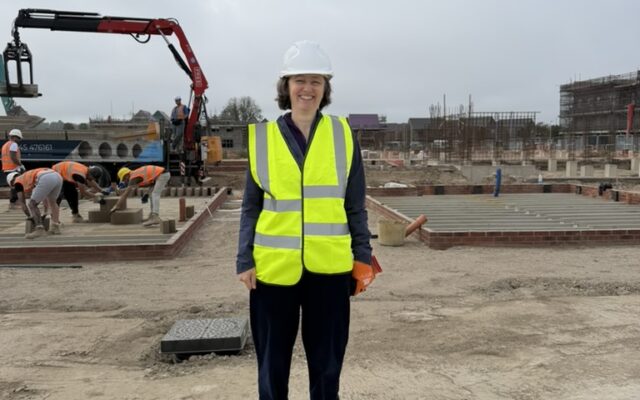
Eddeva Development
I was at the Eddeva development today to hear about progress on the site. I got taken round and shown the progress. Some information about t…
Read more → Blog
Blog
City Council Monthly Report October 2026
In this report: Planning 25/04382/FUL and 25/04383/LBC Market Square 25/04484/FUL 87-93 Oxford Road and Fitzwilliam College Sportsground 25/…
Read more →
Blog
County Council Monthly report October 2026
In this report: LGR STRATEGY, RESOURCES AND PERFORMANCE Quality of Life Council budget consultation ADULTS & HEALTH Tackling obesity CHILDRE…
Read more →
Join the conversation