Full Council
The main item on the agenda was the budget for next year which has to be passed so that council tax bills can be issued for the next year. It comes in two parts, the Housing Revenue Account (HRA) and the General Fund.
The HRA shows large increases in spending (£750,000) on treatment of damp and mould following a change in the law requiring landlords to be aware of the state of their properties and make repairs. The LibDems made no amendments to this part of the budget as this is something we have been requesting for several years.
The General Fund main increases in costs were:
- Yet another reduction in profitability of the crematorium of £300k
- More staff to support renters rights £160k
- Reduced income from Lion’s Yard £400k
- Increase in waste costs partly as a result of the introduction of food waste collection £1,337k
- Housing benefit subsidy loss £636k
Savings
Main items are:
- a large reduction in pension contributions as the pension fund is in a good position £1,280k
- Income from the extended producer responsibility for waste scheme £1,829k
- Car park income £1,400k
The main capital items concerned:
- Fleet replacement programme £2,000k
- Waste vehicle replacement programme £2,036k
The Liberal democrats proposed opening public toilets and providing an electronic means of paying for them so that they could remain open. We also proposed increases in staffing for the open spaces team to enable a more proactive and longer service but these proposals were not voted through.
Housing Advisory Board
The performance of the housing department of the council was reviewed. Among many performance indicators, the total number of cases of damp, condensation and mould complaints to the end of November was 349, of which 204 are live on going cases. Other safety indicators show a high level of compliance, although data is still lacking on some measures.
Tenant satisfaction with the most recent repair stands at 74% and 78% are happy with their new home build.
There will be an increased involvement of tenants under the new Tenant Involvement Strategy through representation on the Housing Advisory Board, resident focus groups, resident ‘Armchair reviewers’ and wider resident consultation.
There is a Housing Improvement plan under which the council is seeking to improve housing quality for residents. There are a number of actions including; sourcing a provider to carry out the stock condition survey to comply with the law, reviewing processes and seeking to engage with tenants more.
Services Climate and Communities Overview and Scrutiny
Climate Change Strategy
The council reviewed the update to the existing Climate change strategy of the council which expires in March 2026. Key findings were:
- The City Council’s own carbon emissions only make up 0.7% of the whole emissions of the city
- These have reduced by 52% from the 2014 baseline and have reduced by 8% since last year.
- Total tonnes of Co2 emitted in 24/25 is 3,871 tonnes.
- The top sources of emissions are as follows:
- Leisure centres and pools 22%, Fleet vehicles i.e. refuse collection and other city vehicles 19%, Sheltered housing communal areas 17%
- The reduction in emissions is mainly from the decarbonisation of the national grid. Other reductions include:
- Electric waste and hydrogenated vegetable oil (HVO) vehicles used to collect waste
- HVO generators used in events put on by the council
- Air source heat pumps at Parkside and Abbey pools
- The main sources of emissions from the city are:
- Domestic heating 25%, Commercial uses 23%, Transport 18% (UK average is 32%)
- Public sector 16% (UK average is 3% – we have a high proportion of university buildings)
The council aims to work with residents and businesses to reduce emissions, adapt to climate change and increase the City’s resilience. A couple of the major ways it will do that is the retrofitting of the Guildhall and the City Centre Heat Network which will use heat exchange mechanism from the water of the Cam to heat buildings in the city.
Homelessness
The council has commissioned a review of the whole system supporting those who are homeless, i.e. policies, operational practice, partnership working with the voluntary sector, funding flows, temporary accommodation, long term resettlement and prevention.
The specific issues in Cambridge are a very high cost private rented sector, a large number of voluntary sector organisations and rising complexity of need. The committee found that a main driver of the rising homelessness in the City is domestic violence. The committee recommended that the strategy needs to focus on the incentives of all those working the sector to ensure they all pull together and that prevention was key.
Planning
There was a review of the Cambridge Investment Partnership (CIP) projects. The CIP is the partnership with Hill that builds the city housing.
Planning applications considered were:
Kett House, Station Road – demolition of the existing building and erection of a new office building. Approved with small amendments to the planting on the Botanical Garden side of the building.
190 High Street, Cherry Hinton – demolition of the existing building and the erection of a new large house of multiple occupation (HMO) together a separate 2 bedroom dwelling. Approved on the Chair’s casting vote.
Tesco, Units 5 and 6 Christ’s Lane – to vary the hours of operation to include Sundays. Approved on the Chair’s casting vote.
The council also heard pre-application developer briefings for
- CambridgeScience Park, Milton Road,
- Residential Blocks and Wild Park north of Cambridge North Station, and
- Land North of Cowley Road and adjacent to Wild Park at land North of Cmabridge North Station.
Cabinet
Community Infrastructure Levy (CIL)
Over half of all planning authorities in the country have adopted a CIL. This will provide additional funds on top of funds raised by s106 planning agreements from new developments. There are currently not enough funds for future planning strategic transport projects and this will address some of that deficit.
Civic affairs and Audit Committee
This committee looks at the governance of the council and manages the financial statements and audit of the council.
The accounts for the year ended 31 March 2025 were approved. These show the following profit and loss account:
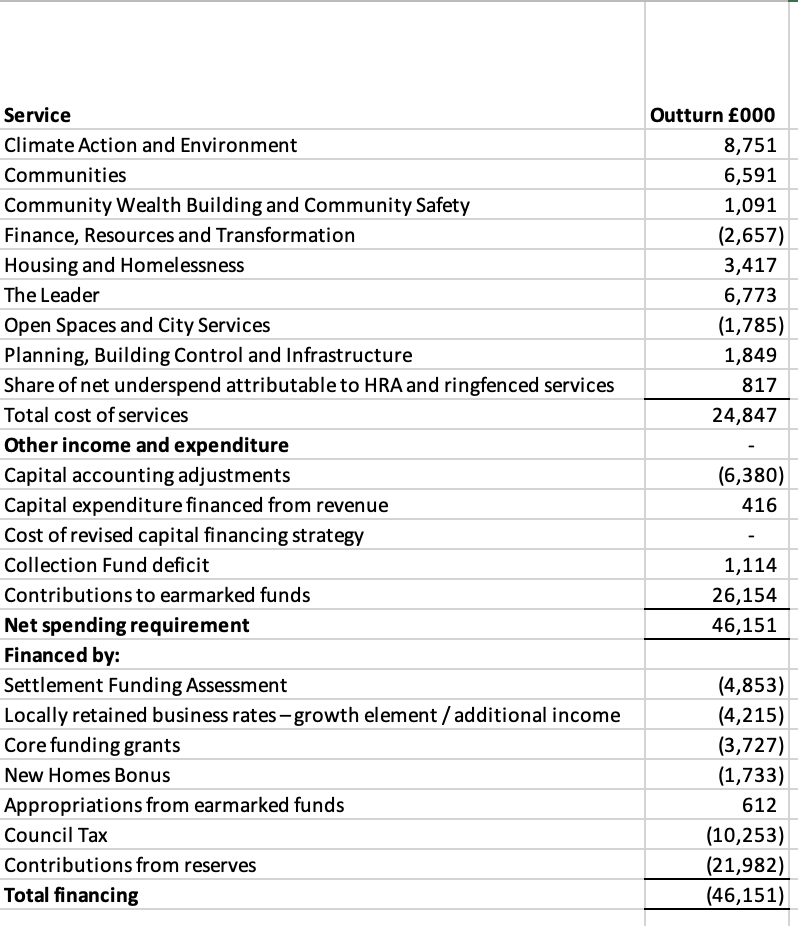
In summary, the council spent a net amount on services, after offsetting income, of £24m.
Employment
Cambridge weighting is paid to employees of the City council and is paid in addition to salary and the real living wage supplement. It was increased from £13.00 per hour to £13.69 per hour.
Leave a Reply
You must be logged in to post a comment.